
Overview
What is the Concrete Slab Calculator?
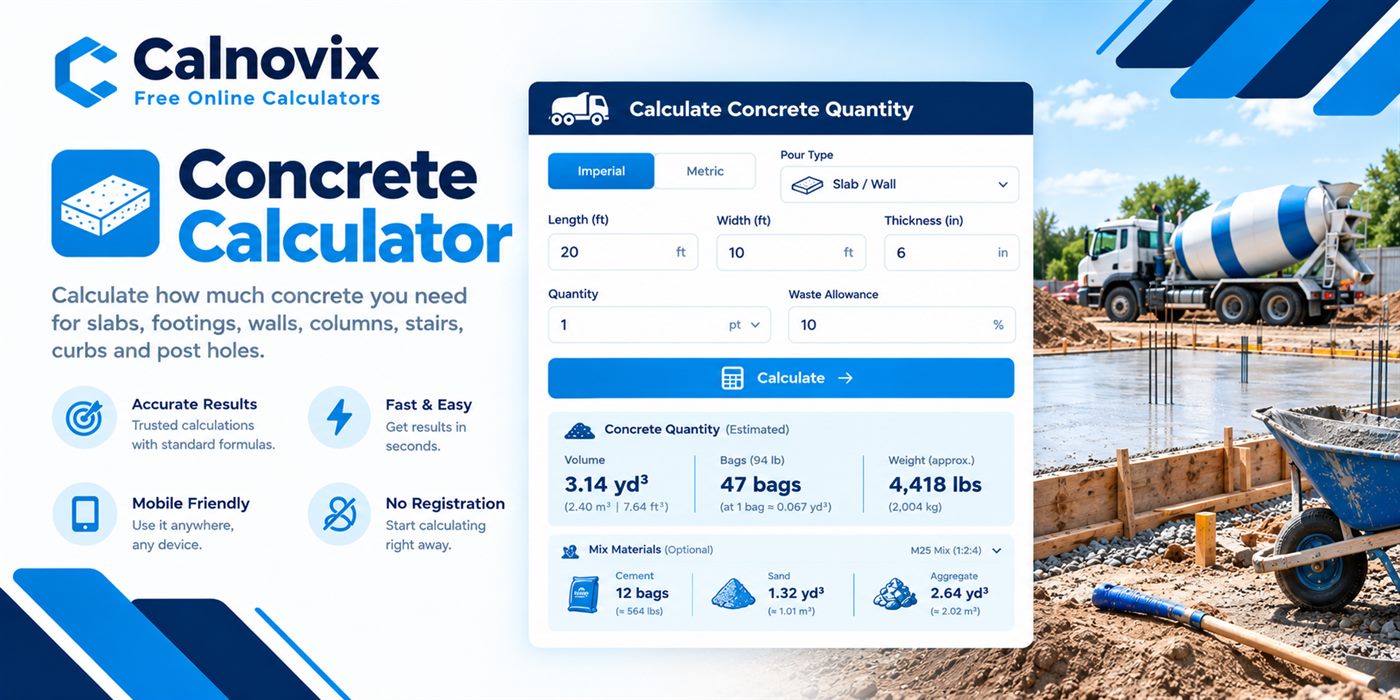
A slab calculator is a rectangular volume tool for flat pours. You measure the plan length and width, set the finished thickness, and convert mixed units — inches for thickness, feet for length — into cubic yards or cubic metres. It does not design reinforcement, joint spacing, or compressive strength.
Need cubic yards for a patio, garage floor, or sidewalk? Enter length, width, and thickness to get slab volume in yards and metres, then bag counts and weight with waste included. Use this slab page before you call the plant so the first load actually covers the forms.
Workflow
How does it work?
The slab engine multiplies length, width, and thickness after converting each field to metres. Quantity repeats identical pads. Waste scales the raw volume by (1 + waste%/100) to cover over-excavation and spillage. Bag counts divide the final cubic feet by typical 40, 50, 60, and 80 lb yields.
Choose Imperial or Metric, then set thickness in inches or millimetres while length and width stay in feet or metres.
Confirm the pour type is Slab so the form uses length × width × thickness.
Enter the measured plan size and the finished slab thickness, not the excavation depth unless you intend to fill that too.
Set quantity to 1 for a single pad, or higher for repeated identical slabs.
Add 5–10% waste for most residential slabs; increase it for rough subgrade or pumped placements.
Read cubic yards, cubic metres, bag counts, and weight before you order.
Math
Formula
Volume = L × W × T × quantity × (1 + waste%)
A rectangular slab is a box: plan length times plan width times thickness. Convert thickness before multiplying — 4 inches is 0.333 feet, not 4 feet. Waste multiplies the raw volume. Bag estimates use published bag yields; weight assumes normal-weight concrete near 2,400 kg/m³.
Inputs
Step-by-step variables
L
Length
Longest plan dimension of the slab, measured on the forms.
W
Width
Shorter plan dimension of the same rectangle.
T
Thickness
Finished slab depth. Watch the unit: 4 inches is a common patio thickness, not 4 feet.
Practice
Step-by-step examples
10 × 12 patio at 4 inches
A 10 ft by 12 ft patio, 4 inches thick, quantity 1, 10% waste. Convert 4 in to 0.333 ft, then 10 × 12 × 0.333 = 40 ft³, which is 1.48 yd³ before waste.
About 1.63 yd³ with 10% waste (≈ 1.25 m³). Ready-mix is usually simpler than bags at this size.
Two 8 × 8 shed pads
Two identical 8 ft × 8 ft pads at 6 inches thick, 5% waste. One pad is 8 × 8 × 0.5 = 32 ft³ (1.19 yd³). Two pads are 2.37 yd³ raw.
About 2.49 yd³ after 5% waste. Enter quantity 2 instead of adding the pads by hand.
Where it helps
Use cases
- Patio and sidewalk takeoffs before a Saturday pour
- Garage and shed floor estimates for a first truck order
- Bag versus ready-mix comparison on small pads
Avoid these
Common mistakes
- Entering thickness in feet when you meant inches, which inflates the order several times over.
- Measuring excavation instead of finished slab thickness when the subgrade will be compacted separately.
- Leaving waste at 0% on outdoor slabs with uneven bases.
Buying & planning
Tips
- Measure twice on the forms, not the drawing scale, before you lock the order.
- Tell dispatch cubic yards, slump, and access — not “a patio’s worth.”
- Above about one cubic yard, ready-mix is usually cheaper than bags.
Need the bigger picture? Read our calculator disclaimer and accuracy policy.