
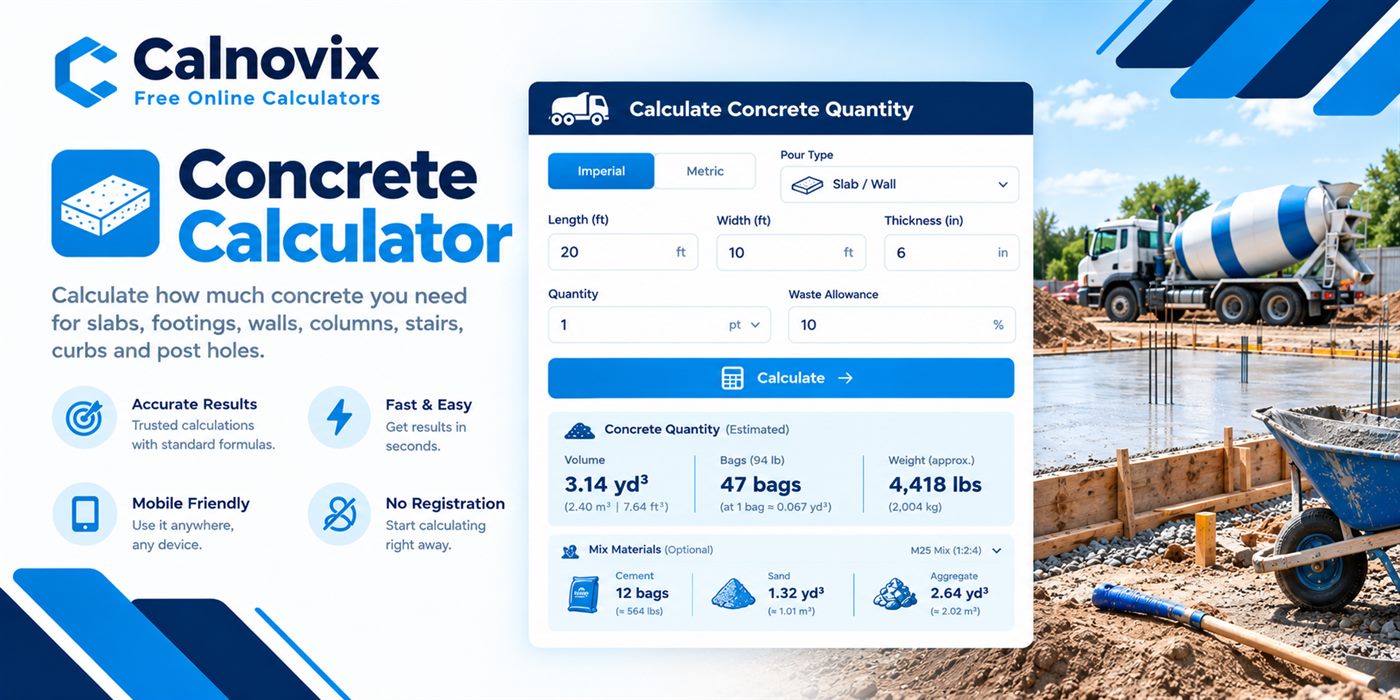
Overview
What is the Post Hole Concrete Calculator?
A post-hole calculator estimates the concrete annulus around a round post. Hole area minus post area, times depth, times how many holes you pour. Leave post diameter blank if you fill the hole solid. It does not choose frost depth or post spacing.
Fence and deck posts need the hole volume minus the post. Enter hole diameter, optional post diameter, and depth, then set quantity for the full run. This post-hole page reports cubic yards and bags so a bagged mix order matches the holes you actually dug, instead of a slab leftover guess.
Workflow
How does it work?
Hole and post diameters convert to metres and become circle areas (πr²). Depth is the pour height in the hole. Net volume is max(0, hole − post) × depth × quantity. Waste then scales the total. Bag counts use the same yields as other concrete pages.
Set Imperial or Metric; hole and post diameters are often inches or millimetres.
Choose Post hole so the form subtracts an optional post diameter.
Enter the dug hole diameter and the pour depth, not the post height above grade.
Enter post diameter if the post occupies space in the hole; skip it for a solid plug.
Set quantity to the number of holes in the run and add a little waste for irregular digging.
Read total bags before you go to the building centre — post pours are usually bag jobs.
Math
Formula
Volume = (πR² − πr²) × depth × quantity × (1 + waste%)
R is the hole radius and r is the post radius. If no post diameter is entered, the post term is zero and you fill the full cylinder. Depth is the concrete in the hole. Quantity repeats identical holes. Waste covers over-dig. This is the post-hole case in the shared concrete engine.
Inputs
Step-by-step variables
D
Hole diameter
Diameter of the dug hole, measured across the opening.
d
Post diameter
Optional diameter of a round post occupying the hole. Omit for a solid fill.
H
Depth
Depth of concrete in the hole, not the above-grade post height.
Practice
Step-by-step examples
Eight 12 in holes, 4 in posts, 2 ft deep
Hole radius 0.5 ft, post radius 0.167 ft, depth 2 ft, quantity 8, 10% waste. Net area is π(0.25 − 0.028) ≈ 0.70 ft². One hole is about 1.40 ft³.
About 0.41 yd³ raw for eight holes, or roughly 0.46 yd³ with 10% waste — typically a bagged mix run.
One 10 in solid plug, 30 in deep, no post offset
Leave post diameter empty. Cylinder volume is π × (5/12 ft)² × 2.5 ft ≈ 1.36 ft³ for a single hole.
About 0.056 yd³ including 10% waste. Check 50 lb or 80 lb bag yield on the result card for a single repair.
Where it helps
Use cases
- Fence-line posts poured in one afternoon
- Deck posts where the spec calls for a concrete collar
- Mailbox or sign posts with a bagged mix
Avoid these
Common mistakes
- Using above-grade post height as hole depth.
- Forgetting quantity on a long fence, which under-orders bags by a factor of the post count.
- Subtracting a square post as if it were round without checking the actual section.
Buying & planning
Tips
- Dig consistently; a 2-inch wider hole changes bag counts across a long run.
- Brace the post plumb before the mix stiffens.
- Above a couple of dozen holes, compare bags with a small ready-mix order for labour time.
Need the bigger picture? Read our calculator disclaimer and accuracy policy.